

Economic Perspective 28 November 2025
- Dec 5, 2025
- 3 min read
The Latest Trending Economic News Curated for You by Balmoral Group Australia
Good morning dear readers,
This week our focus is on government-led reform and environment. Overhauls to Australia’s environmental protection law have finally been passed, although specifics on implementation are still up in the air. The government have also released the National AI Plan, establishing a roadmap towards boosting Australia’s AI take-up, capacity and safety measures.
Additionally, we have included two research articles that investigate Australia’s unique industrial conditions. The first, a 2024 study, models the job-creation effects of different Net-Zero transition pathways, finding that both domestic and export-orientated energy sectors will see strong job growth through 2060. The second discusses Australia’s unique agricultural pressures and highlights the need for updated dietary guidelines to reflect these constraints.
Please feel free to forward this to anyone you think would be interested. If you’d like to view previous editions, please click here and navigate the News tab, or to subscribe, please click here!
Hope you enjoy the articles and have a great weekend!


Long-sought environmental law reform is finally here. But will the compromise deal actually protect nature?
New environmental laws reforming the EPBC Act have finally been passed. The proposed bills were amended to tighten ministerial discretion, remove fossil projects from fast-approval tracks, protect native forests and reword “unacceptable impact” definitions. Previously, Australia’s environmental law allowed many projects to go unassessed, and 99% of those assessed went on to be approved. The government still needs to publish environmental standards and hash out implementation details, so stay tuned. Read more here.

Labour implications of the net-zero transition and clean energy exports in Australia
This 2024 research paper simulated a range of net-zero transition scenarios, finding that by 2060 the domestic Australian energy sector may have an additional 210-490 thousand jobs, while energy exports may gain 350-510 thousand jobs – increasing the energy sector’s share of employment from 1% to 3-4% of the Australian workforce. Employment will come from sustained construction, ongoing operations and maintenance. The paper predicted that the primary domestic energy jobs will comprise utility solar photovoltaics (PV), onshore wind, batteries and electricity transmission and distribution, while export market jobs will originate from clean hydrogen production and shipping supply chains.

National AI Plan published on Tuesday
The Australian Government’s new National AI Plan sets three key goals: capture opportunities, spread benefits and minimise harm. Each pillar is flanked by three actions. The most notable tasks include the expansion of digital infrastructure, such as data centres, NBN and cybersecurity systems, attracting investment, supporting business adoption, improving vocational AI training, embedding AI in public services, and creating safety measures for AI in schools and content-generation. Access the plan here.

The way Australia produces food is unique. Our updated dietary guidelines have to recognise this
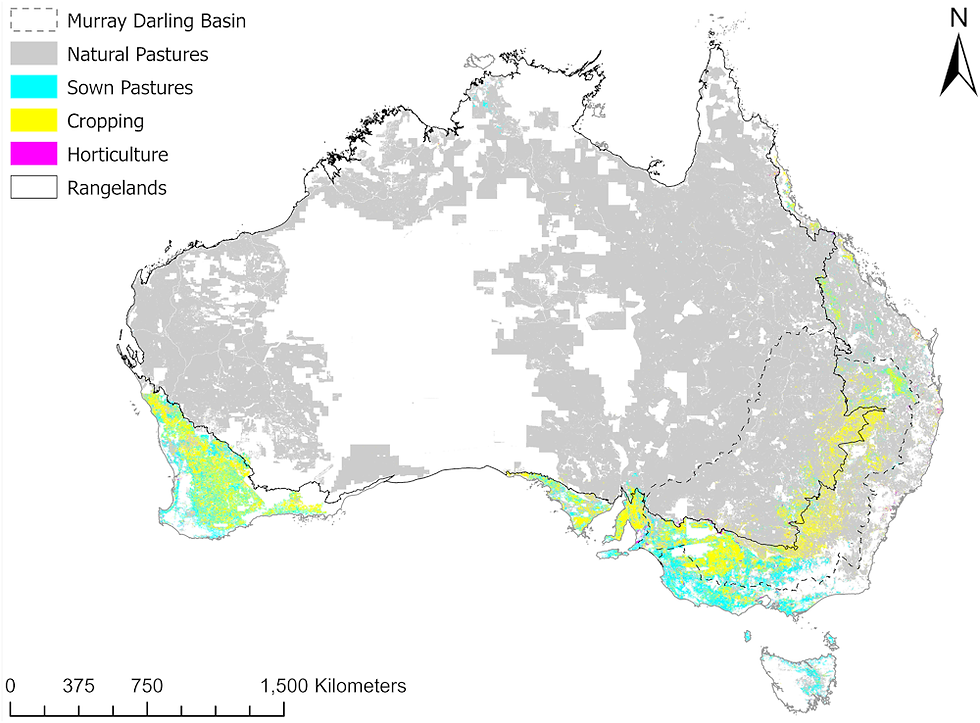
National dietary guidelines have previously used generalised indicators of sustainability called “load indicators” including greenhouse gas emissions, land-use and water-use per unit of food produced, pollution and biodiversity loss. Australian conditions often do not fit these indicators – specifically for land and water use. Australian agricultural regions are often too dry for cropping or horticulture, and livestock must be spread over vast distances – making land and water use metrics misleading. As such, Australian dietary guidelines should be updated to account for the unique pressures facing food production. Read more here, and see the article’s land-use map below.
Australian Agricultural Land Use
This visualisation from Masters et al. (see here for the source article) shows Australia’s diverse food production systems. Rangelands and natural pasture account for the largest area, followed by mixed crop-livestock zones (in light blue and yellow).
Connect with Balmoral Group Australia Here


Sharp economic analysis like this is exactly what managers need to stay ahead — understanding what November 2025's shifts mean for pricing, demand, and strategy can make a real difference in how confidently you lead. Those building that edge are exploring a managerial economics course & workshop for managers in Melbourne, Australia — a practical space where economic thinking meets everyday business decision-making.
Articles like this are especially valuable because they connect policy decisions, market conditions, and business expectations into a broader picture of economic performance. The discussion encourages readers to think critically about growth, inflation, and long-term competitiveness—topics that are frequently examined in a managerial economics seminar & course in Melbourne, Australia, where executives learn how economic insights can support more effective strategic decision-making.